Here is how the week closed and what I’m watching next.
Where the indexes closed
The S&P 500 finished Friday at 7,580.07, down 1.82% on the day, its worst day since June. It lost 0.6% for the week, its third straight weekly loss. The Nasdaq Composite fell 2.86% Friday to 25,437.00 and 2.0% for the week. The Dow closed at 51,770.31, down 1.09% Friday and 0.9% for the week. The Russell 2000 dropped 1.66% Friday to 2,811.84 but still finished the week up 1.3%.
How price behaved at the levels that mattered
Last week I had 7,631.77 on the S&P 500 as the old floor, now overhead, with 7,765.36 above it. Beneath, last Friday’s low of 7,612.07 and the September 16 low of 7,507.77.
Monday opened just above that old floor and closed well above it at 7,676.77. Buyers pushed price up to a Wednesday high of 7,758.43, and once again it stopped short of 7,765.36. That level has now turned price back four times since mid October. Friday the index opened at 7,631.07, right on the old floor, and never got going. It traded down to 7,527.56 and closed at 7,580.07, below last Friday’s low and at its lowest close since September 16. The September 16 low of 7,507.77 sits about 20 points under Friday’s low. The S&P 500 is still only about 3% below its record high. The Nasdaq hit its lowest level in nearly three months and finished about 8% below its October 6 record close.
What showed beneath the surface
Friday was a technology selloff more than a market-wide panic. Technology fell 4.89%, industrials fell 1.60% and communication services fell 1.29%. Energy led at +1.91%, consumer staples gained 1.41%, utilities 0.67% and health care 0.45%. ExxonMobil and Chevron both rose after their earnings. Within the S&P 500, 226 stocks rose and 277 fell, close to even, but only 32% of volume went into rising stocks. Thursday told the same story: on Alphabet’s worst day ever, 406 S&P 500 stocks rose and only 97 fell, and the Russell 2000 gained 1%. About 59% of S&P 500 stocks still held above their 50-day average Friday. Money is rotating out of the AI names, not out of the market.
Volatility woke up. The VIX drifted down to 16.91 on Wednesday, then jumped 12.9% Friday to close at 19.42, right back where it finished last week.
Rates eased while oil rose, which is unusual. The 10-year Treasury yield finished Friday at 4.94%, down from 5.00% a week earlier and back under 5%. The 2-year finished at 4.56%, down from 4.69%. AP read that as investors buying government bonds in search of safety.
Oil kept climbing. WTI settled at $104.12, up 2.1% Friday and 0.8% on the week. Brent’s expiring December contract settled at $117.64, its highest settlement since late April. For October, Brent gained 13.6% and WTI 15.2%. The drivers were a tanker attack in the Strait of Hormuz, Houthi claims of attacks on Saudi energy facilities, and worry about renewed U.S. military action against Iran. Comex gold settled at $3,885.70, down 3.3% Friday, 2.7% for the week and 6.5% for October. The dollar index was near 101.90 late Friday, little changed from 101.75 a week earlier.
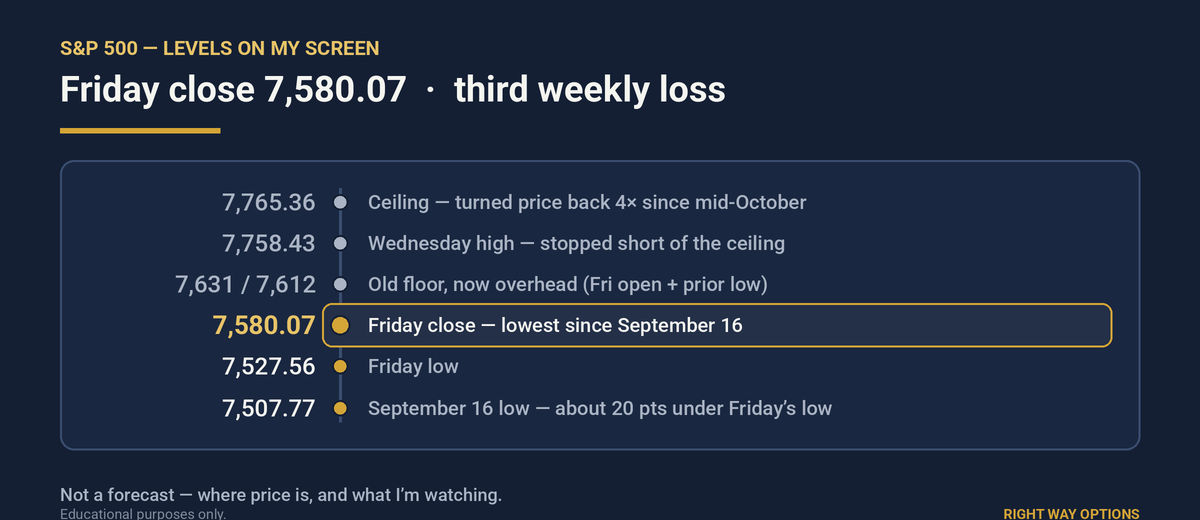
S&P 500 levels I’m watching.
Special focus: fear in the tape, and chips on deck
You could feel it this week. Fear is building. The worst day since June, a 9.1% one-day drop in the chip ETF, Intel's worst day since 1974 and a VIX that jumped almost 13% in a session all point to the same thing: traders are nervous, and nervous markets swing harder in both directions. That is the environment we are trading in right now, so it is the one I'm respecting.
The chip names stay in the spotlight this week. AMD fell 11% Friday heading into its own report Tuesday, Nvidia fell 4.2%, and Apple, Palantir, AMD and Qualcomm all report within three days. I am not guessing how those reports land. I'm noting that each one can move the whole tech complex overnight, and that a gap at the open is something a stop can't protect you from.
The week ahead: what I'm watching
A packed week: the midterm election, the next wave of AI and chip earnings, and the October jobs report on Friday. All times are Eastern.
- Monday: S&P Global manufacturing PMI at 9:45 AM, then ISM manufacturing and construction spending at 10:00 AM. Chicago Fed President Austan Goolsbee speaks at 11:15 AM. Marriott and IDEXX report before the open. Apple, Palantir and onsemi report after the close.
- Tuesday: Midterm Election Day. JOLTS job openings, factory orders and final durable goods orders at 10:00 AM. AMD reports after the close. Pfizer, Amgen, Booking, Arista Networks and Super Micro Computer also report.
- Wednesday: ADP employment at 8:15 AM, trade balance at 8:30 AM, and ISM services at 10:00 AM. Qualcomm, McDonald's, Uber, AppLovin, DoorDash and CVS Health report.
- Thursday: Weekly jobless claims plus third quarter productivity and unit labor costs at 8:30 AM. Airbnb, ConocoPhillips, Duke Energy and Cigna report.
- Friday: October jobs report at 8:30 AM. FactSet's consensus calls for 55,000 jobs with unemployment at 4.2%. University of Michigan sentiment at 10:00 AM.
The big three this week: Apple, Palantir and AMD
Apple reports after the close Monday, with results at 4:30 PM ET and the call at 5:00 PM ET. Palantir also reports after Monday's close, with its webcast at 5:00 PM ET. AMD reports after the close Tuesday, Election Day, with its call at 5:00 PM ET.
These three can move far more than their own shares. Apple is one of the largest weights in the S&P 500 and the Nasdaq. Palantir and AMD sit right in the middle of the AI trade that just got hit, and AMD fell 11% Friday on the chip selloff alone.
Most of the reaction will show up as a gap at the next morning's open. Know your exposure going into Monday's and Tuesday's close, and size for a gap, not for your stop.
The levels on my screen: On the S&P 500, 7,612.07 and the 7,631 area are now overhead, the old floor and Friday's open. Above that, 7,758.43 and 7,765.36, the ceiling that has held since mid October. Beneath, Friday's low of 7,527.56, then the September 16 low of 7,507.77. CNBC noted the 200-day average near 7,306. On the Nasdaq, Friday's close of 25,437, near a three-month low. On the VIX, the 20 area. On rates, 5% on the 10-year, now overhead. On oil, $104 on WTI and the late April highs on Brent.
None of this is a forecast. It is where price is and what is on the calendar. With an election and the biggest chip and AI reports all in the first two days, let the reactions settle before acting on them. Wait for confirmation at the levels, control risk, and remember that cash is a position.
COACHING
Coaching: slow down after a loss
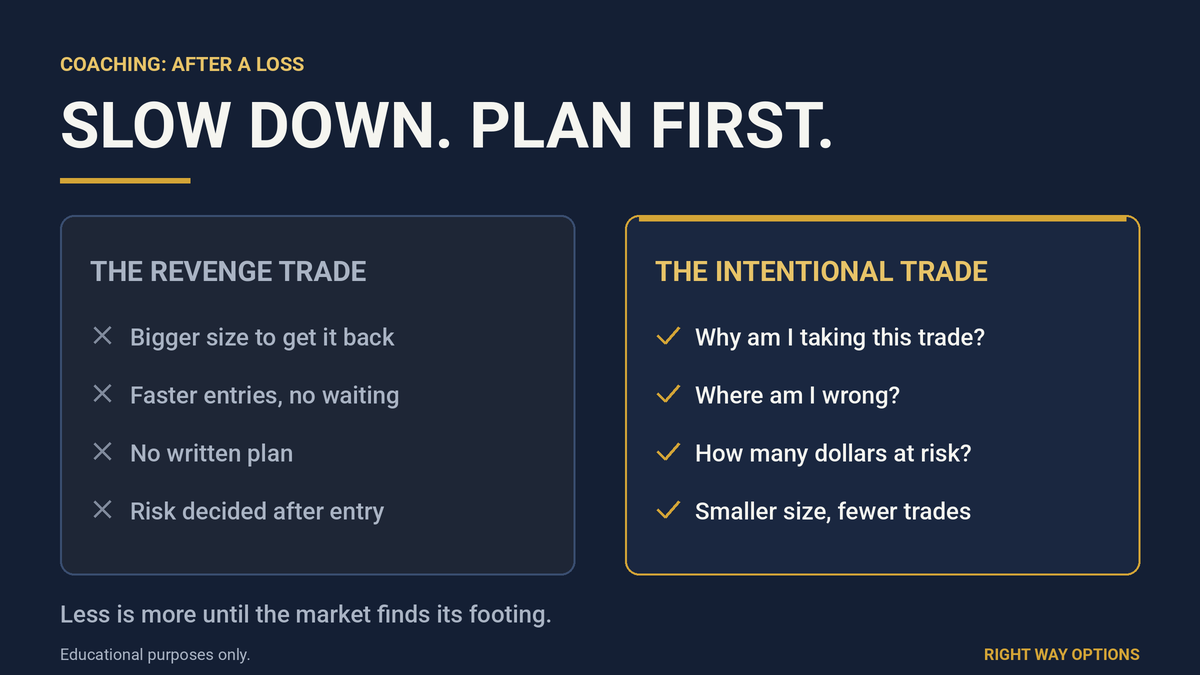
When fear builds and the swings get bigger, the most expensive trade is usually the one you take right after a loss. That's the revenge trade: bigger size, faster entries, no plan, all to get the money back. The clues right now say slow down. Take fewer trades and make every one intentional. Before you enter, write down three things: why you're taking it, where you're wrong, and how many dollars you're risking. If you can't answer all three, you don't have a trade yet. Less is more until the market finds its footing. Protecting capital is the job, and the next good setup will still be there.
If you want help planning the day before you trade it, my free Market Prep Center lays out the market story, the decision windows, the economic reports and notable earnings before the open. It updates at 5:30 AM, 12:30 PM and 4:30 PM ET.
Doug
Educational purposes only. Nothing provided by Right Way Options constitutes investment advice or a recommendation to buy or sell any security. Trading involves risk.